
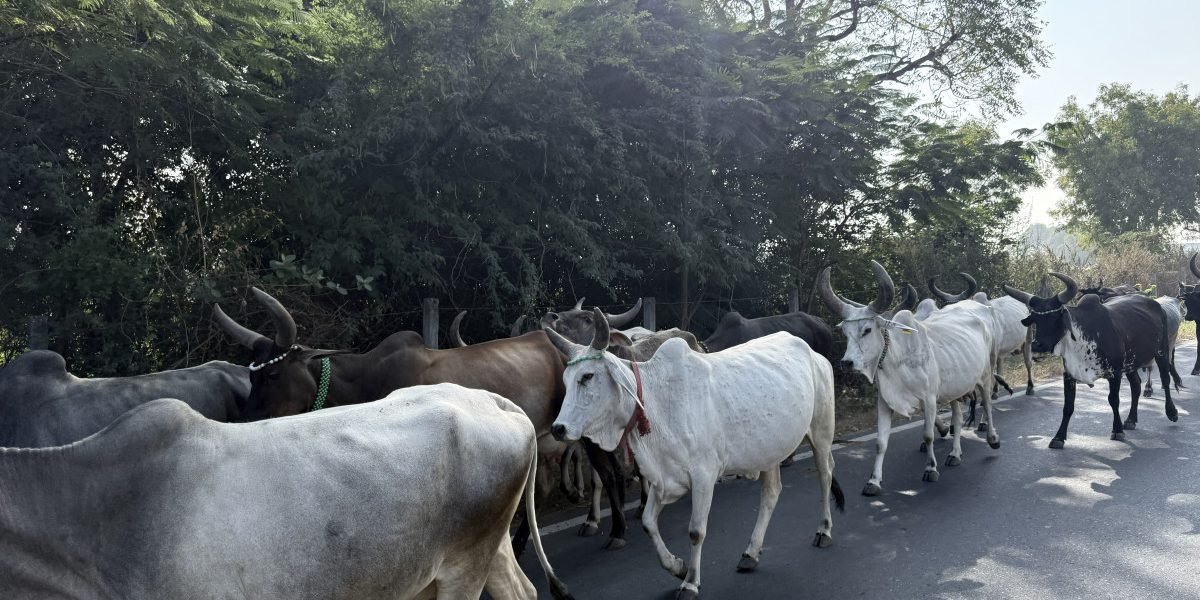
Gujarat, and its adjoining Dadra & Nagar Haveli and Daman & Diu are the only places in India where cow slaughter can lead to life imprisonment.
Credit: The Wire
The Gandhinagar Sessions Court sentenced three accused to life imprisonment under the Gujarat Animal Preservation Act, 1954, in a case involving 277 kg of beef. However, the judgment attracted particular attention for its extensive reliance on Hindu religious scriptures. Referring to the Manusmriti, the court observed that Sage Manu assigned the responsibility of protecting cattle to the Vaishya community and highlighted the significance of a cow and bull in the traditional form of Vedic marriage known as Arsha Vivaha
Going further, the judge invoked Vedic references to Kamadhenu, describing the cow as the ‘mother of the world’, an abode of 33 crore deities, with its four legs symbolising the four Vedas. These observations went beyond a passing reference to cultural traditions and presented the cow’s religious and spiritual significance as part of the court’s reasoning
Article 48 of Indian Constitution must be read alongside Article 37, which makes Directive Principles non-justiciable while declaring them fundamental to the governance of the country. Thus, Article 48 provides a constitutional basis for cattle preservation, but it does not independently create a criminal offence or authorise life imprisonment.
The distinction is crucial. Cattle preservation may be a legitimate constitutional and legislative objective, however, its implementation must remain consistent with fundamental rights, secularism and the rule of law. Neither a religious scripture nor a political endorsement can replace constitutional standards in criminal adjudication.
The central concern, therefore, is whether religious morality and political narratives are beginning to influence the interpretation of criminal law in India, and where the judiciary must draw the line.
