
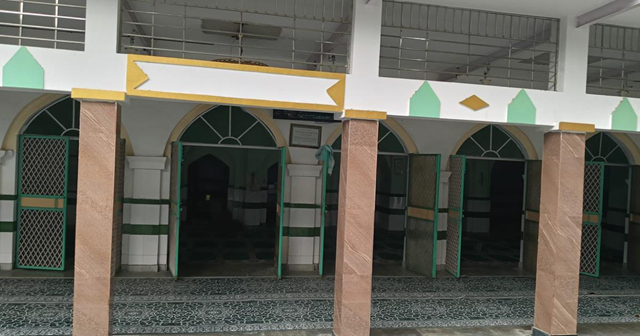
Credit: Scroll
Race Course mosque, New Delhi | Amanatullah Khan AAP, @KhanAmanatullah/X
Yet again in a series of arbitrary demolitions of Muslim religious institutions, the historic Race Course Masjid in New Delhi faces the threat of removal. The Land and Development Office issued a six-day eviction notice labelling the pre-colonial mosque and its cemetery an unauthorized encroachment, cutting off its water and power connections. The mosque authorities claimed that it was notified as a gazetted Waqf property in 1977 and placed on the heritage register of the New Delhi Municipal Council in 2009. AIMIM chief Asaduddin Owaisi called on Union Minority Affairs Minister Kiren Rijiju to intervene in the mosque case. In a post on X, Owaisi said, “Despite the masjid being a gazetted waqf property since 1977, the waqf board did not challenge the demolition order. Neither did it make any effort to resolve the issue.” He also questioned the Delhi Waqf Board’s failure to act. On October 19, a delegation led by the Jamiat Ulama-i-Hind general secretary, Maulana Muhammad Hakimuddin Qasmi, met Union Minority Affairs Minister Kiren Rijiju submitted a memorandum on behalf of its president, Maulana Mahmood Asad Madani. According to Jamiat’s official statement, Rijiju assured the delegation that he would make every possible effort to address the matter.
Over the last decade, hundreds of Muslim religious structures have been either fully or partially demolished. In September 2026 alone, according to a report by Islamophobia Monitor titled “India’s Mosques Under Attack: Demolitions, Threats and Rising Islamophobia”, at least seven mosques across India were fully or partially demolished. These actions follow a clear pattern. Local authorities label mosques as illegal encroachments or claim they stand over older temples. They issue short eviction notices and bring in bulldozers before caretakers have time to approach a court or secure legal protection.
The silence surrounding these actions has normalized an arbitrary process that bypasses every standard legal procedure, violating not only the very fundamental rights but also raises serious concerns about democracy and rule of law itself. Over the past six years, more than 2,100 Muslim religious sites have faced demolitions or damages, a pattern that makes claims of neutral urban planning impossible to sustain. The question is no longer whether these actions are arbitrary, but how long Indian judiciary can watch administrative fiat replace the rule of law.
