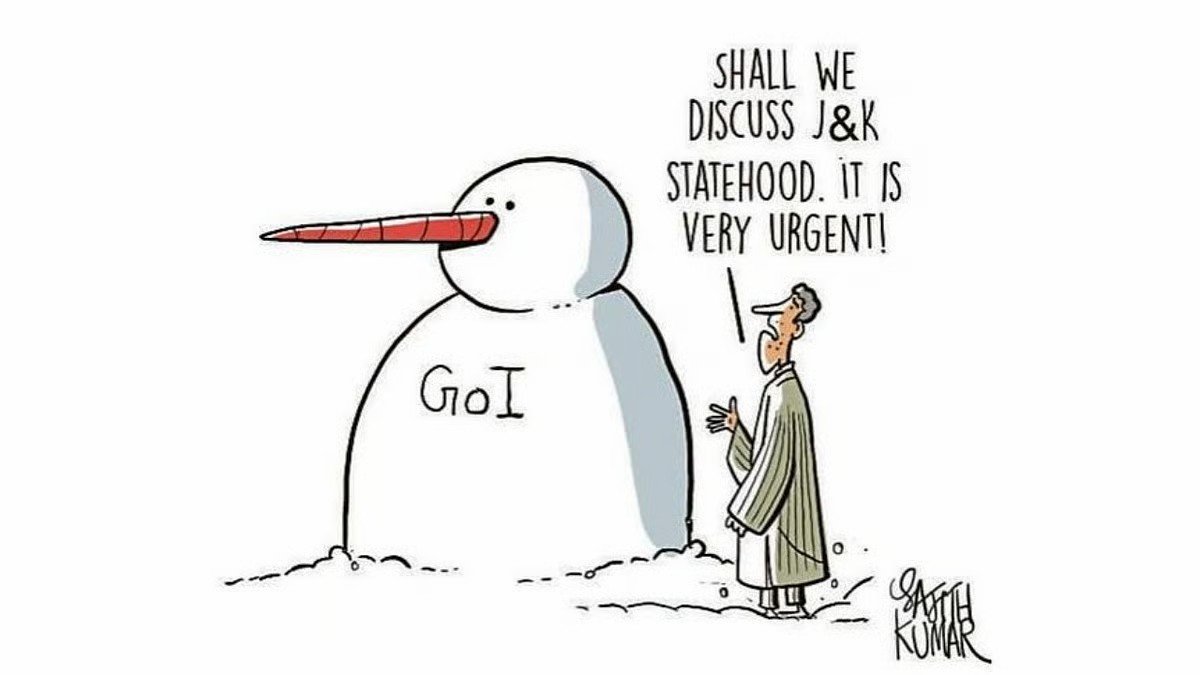
Credit: Deccan Herald
Seven years since losing statehood. It began with the abrogation of Article 370, which the BJP’s election manifestos of 2009, 2014, and 2019 long affirmed. This sowed the seeds for stripping away statehood since Independence after the removal of Delhi’s statehood in 1956. On 5th August 2019, the Union government abrogated Article 370 and annulled Article 35A. It passed the Jammu and Kashmir Reorganisation Act, dividing the state into two UTs, Jammu and Ladakh and stripping it of its special status. All of this was done without consultation with the people of Jammu and Kashmir, violating Articles 1 and 3 of the Indian Constitution.
The first promise of restoring statehood was made in Nov 2019 on the floor of the parliament by the Union Home Minister. He laid down a three-phase trajectory: i) delimitation (2022), ii) Elections (2024) and iii) statehood. In 2023, the Union government assured the S.C that the UT arrangement was temporary and statehood would be restored at the earliest, with no clear definition of an appropriate timeline.
In Aug 2019, there was less violence and no terrorist attacks in the month preceding the revocation of Article 370. If preventing violence and terrorist attacks were one of the major concerns, it would mean that states like Assam, Punjab, Gujarat and Manipur, which have witnessed large-scale violence and terrorism, would be stripped away of their statehood. Cross-border terrorism comes from Pakistan-held territories of J&K; if restoration of statehood is denied on the premise of cross-border terrorism, it ultimately translates to “when Pakistan stops terrorism, statehood will be restored”.
The heavy-handed security approach has led to crackdowns, banning of dissent, censoring books, curtailing free speech, and imposing curfews, including arbitrary arrests under the PSA and UAPA for hypothetical reasons. Unemployment has sharply surged compared to the pre-2019 period. All of this guarantees more resentment and violence.
An unelected government answers to Delhi, not to the people it governs. Administrators unfamiliar with the economic structures and culture of Kashmiris have made things worse, not better. A country that fails to consult the people of the respective state before altering its status has undermined the very essence of democracy.