
Credit: Bar and Bench
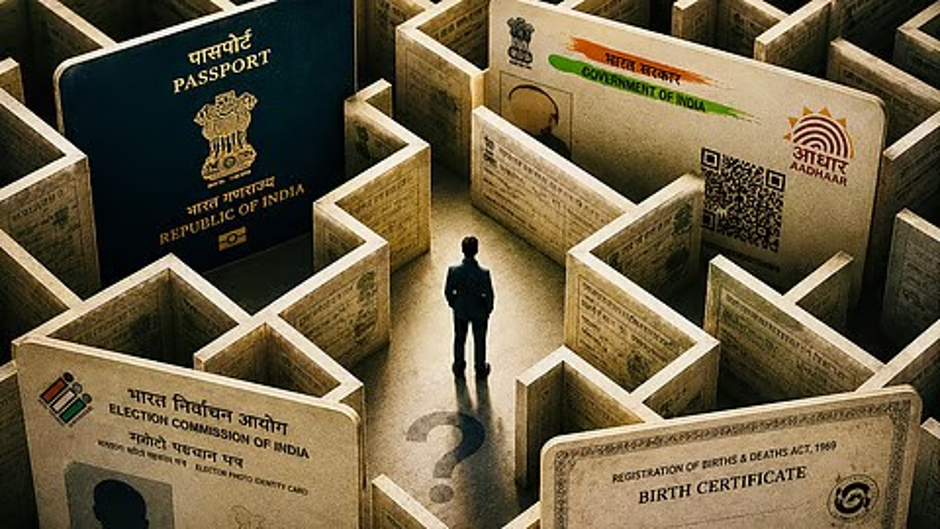
The debates around citizenship and what documents constitute proof of citizenship have spread like a forest fire after a controversial statement made by the Ministry of External Affairs in a press meeting, which stated that the passport is a mere travel document and is not a proof of citizenship. Since even foreigners could acquire an Indian passport under special circumstances (The Passport Act of 1967).
A passport is issued by the MEA only after thorough investigation by local police and the state’s satisfaction with the individual’s citizenship. With no official data on how many foreigners have obtained an Indian passport, making the claim is delusional.
Articles 5-11 of the Indian Constitution and the Citizenship Act of 1955 provide for citizenship by Birth, descent, naturalization, registration and acquisition.
However, the CAA, 2003, made Jus soli (right by birth) conditional and ineligible for citizenship. It introduced the term, illegal migrant and did not apply to migrants of other faiths except Islam. The CAA,2019, was aimed at facilitating a fast-track citizenship mechanism for migrants other than Muslims. Thereby introducing religious-based differentiation into secular law.
Under the CAA,1955, if a person is suspected of being a citizen, the burden of proof lies with the state. This is in contrast with a colonial Act, the Foreigners Act 1946, which places the burden of proof on the suspected individual. Drawing parallels with NPR (2015), where any person can report their neighbour as a foreigner and bear no proof for such claims. The NRC (2019) places an entire population under suspicion. In SIR, anyone from the same assembly constituency can submit any number of objections to the voter’s status of any no of persons.
These acts, though they seem distinct, boil down to the creation of second-class citizens and derogatory laws that undermine constitutional democracy, which ensures citizenship to all regardless of race, faith, caste, creed, gender, etc.
When the whole population is not citizen enough, with nearly 64.3% of the population depending on welfare schemes (PIB2024), the cancellation of citizenship would leave a large chunk of the population stripped of their fundamental rights, leading to serious consequences.
When presumption becomes the basis of citizenship, the question of accountability is left blank.